Posts

Showing posts with the label Palliative Care

Islamic Activism and Palliative Care: An Analysis from Kerala, India

Image
Religion has re-emerged as a significant force in the political and socio-cultural spheres, with growing interest in its intersections with development. This chapter examines the Islamic activism within the palliative care movement in Malappuram, a Muslim-majority district of Kerala, India, against the backdrop of the state's unique developmental model. The institutionalized delivery of palliative care in Kerala, supported by local communities and both religious and non-religious civil society organizations, has evolved into a mass movement. The study highlights the transformative role of Muslim organizations in this initiative, which represents a shift in their social engagement dynamics. The chapter situates this activism within the broader framework of religious civil society, exploring its interaction with the state amidst neoliberal reforms and decentralization efforts. Kerala's distinctive political and developmental context, including its secular public domain and mult...

A Comparative Study to Assess the Awareness of Palliative Care Between Urban and Rural Areas of Ernakulum District, Kerala, India

Image
Palliative care is a comprehensive approach aimed at enhancing the quality of life for patients and their families dealing with life-threatening illnesses. By addressing physical, psychosocial, and spiritual needs, palliative care seeks to alleviate suffering and maintain dignity during challenging times. This research aimed to evaluate the awareness and attitudes toward palliative care among residents of urban and rural areas in the Ernakulam district, Kerala, India. A cross-sectional study was conducted involving 350 households, comprising 185 from urban areas and 165 from rural areas. The senior-most member of each household was interviewed using a pre-designed questionnaire, focusing on their awareness, sources of information, and attitudes toward palliative care. The study findings revealed a significant disparity in awareness levels between urban and rural participants. While 13.4% of the total respondents had heard about palliative care, awareness was considerably higher in urb...

Understanding caregiver burden and quality of life in Kerala’s primary palliative care program: a mixed methods study from caregivers and providers’ perspectives

Image
The study explores the caregiver burden and quality of life (QoL) among caregivers of palliative care patients in Kerala, India, with a particular focus on aging caregivers. Kerala’s decentralized health governance system, which has been operating for almost three decades, has pioneered a community-driven approach to palliative care. This program heavily depends on family caregivers , who face numerous challenges, including physical, psychological, social, and financial burdens. Despite these challenges, caregiver issues remain under-addressed in the program’s design and implementation. A mixed-methods approach was adopted, combining a cross-sectional survey of 221 caregivers and in-depth interviews with caregivers and palliative care nurses. The survey utilized tools such as the Achutha Menon Centre Caregiver Burden Inventory and EuroQol EQ-5D-5L to measure caregiver burden and QoL. Qualitative data were obtained through interviews with caregivers and nurses, exploring their perc...

Palliative Care in Kerala, India: A Model for Resource-Poor Settings

Image
The growing need for palliative care globally is especially critical in resource-poor settings, where patients with advanced cancer, AIDS, and other chronic conditions often lack access to treatment. In Kerala, India, the Pain and Palliative Care Society (PPCS) developed a pioneering model for community-based palliative care. Beginning as a small outpatient service in Calicut in 1993, PPCS has expanded into a network of 33 clinics offering free care to patients with terminal illnesses. This model emphasizes community participation, family empowerment, and the use of local resources. Trained volunteers support patients through home care and outpatient services, ensuring holistic care that addresses physical, emotional, and social needs. By 2002, this network was treating approximately 6,000 new patients annually, covering about 25% of the need among newly diagnosed cancer patients. A notable success of this initiative is the " Network Neighborhood for Palliative Care " estab...

Is the Kerala Model of Community‑Based Palliative Care Operations Sustainable? Evidence from the Field

Image
The Kerala model of community-based palliative care is often celebrated as a sustainable and inclusive approach to providing holistic healthcare to individuals with life-limiting illnesses. This study explores the sustainability of the Kerala model by examining ten selected palliative care units across the Malappuram and Palakkad districts, focusing on three key dimensions of sustainability: patient care, economic self-sufficiency, and voluntary support. The research highlights how the model ensures uninterrupted, cost-free, and comprehensive care, encompassing physical, psychological, spiritual, and economic support for patients and their families. In Malappuram , where palliative care services are particularly robust, there are approximately 112 palliative care units operated by local self-governments, complemented by an additional 90 community-led or NGO-run units. This extensive network demonstrates Malappuram’s critical role in implementing and sustaining community-based care. T...

Social Capital and Sustainable Health Care: An Analysis of Community Based Palliative Care Model of Kerala

Image
The district of Malappuram holds a significant place in the community-based palliative care movement in Kerala. As highlighted in this study, Malappuram, along with Kozhikode, accounts for the largest number of palliative care units in India , and these two districts are recognized as the origin of the palliative care movement in the country. The analysis underscores the pivotal role of Malappuram in advancing a sustainable, community-driven model of health care that extensively leverages social capital. One of the standout features of the palliative care movement in Malappuram is the active involvement of the local community . The study reveals that the success of the palliative care model in this district is significantly influenced by the cohesion and cooperation among the population , particularly the Muslim community, which has played an essential role in supporting and sustaining the movement during its formative years. This strong sense of community solidarity has translated in...

Review of Community-based Health Care Movement and Palliative Care in Kerala

Image
  Palliative care is a relatively new concept in the Indian healthcare landscape , arising from the need to address the challenges posed by changing family structures, increasing life expectancy, and evolving epidemiological trends. In this context, Kerala’s community-based palliative care movement has emerged as a pioneering model that combines decentralized public health delivery with active community participation. This abstract reviews the palliative care policy of Kerala, highlighting its innovative features, socio-economic impact, and broader implications for public health in India. Kerala’s palliative care model is unique due to its emphasis on community-based interventions, economic sustainability, and integration with local self-governments. Initially focused on end-of-life care and pain management, the scope of palliative care has expanded to address the bio-psychosocial and spiritual needs of patients and families . This approach has garnered global recognition, includ...

Palliative care: a public health priority in developing countries

Image
Palliative care is emerging as a critical discipline in the global health landscape, yet it remains largely underdeveloped in many developing countries. This article highlights the disparity in palliative care services between developed and developing nations, emphasizing the urgent need to prioritize it as a public health issue. With millions of deaths annually attributed to cancer, HIV/AIDS, and other chronic illnesses, most of these occurring in resource-poor countries, the demand for palliative care far exceeds the available services. Inadequate government commitment, limited opioid availability, and insufficient education are identified as the primary barriers impeding the development and delivery of effective palliative care in these regions. The World Health Organization (WHO) defines palliative care as an approach that enhances the quality of life of patients and their families by addressing physical, psychological, and spiritual suffering. However, delivering effective palliat...

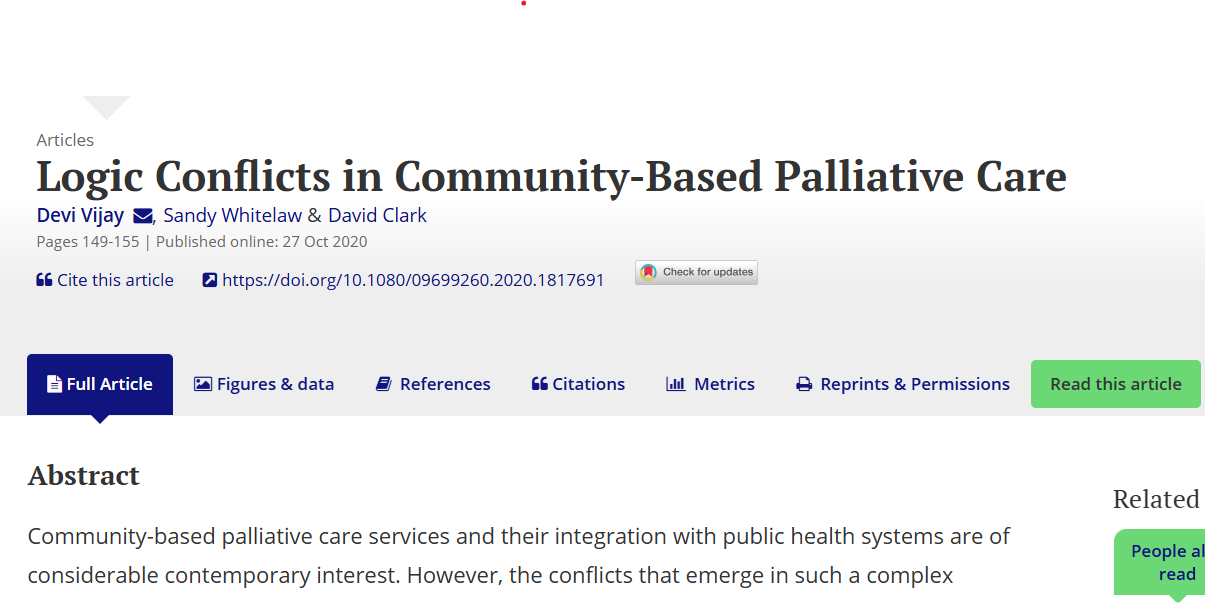
Logic Conflicts in Community-Based Palliative Care

Image
The paper "Logic Conflicts in Community-Based Palliative Care" examines the challenges and opportunities within community-based palliative care systems, using Kerala, India, as a case study. Kerala's model, recognized for its emphasis on community ownership, total care, and integration with public health systems, serves as a critical lens to explore organizational conflicts. The study identifies four central "logic conflicts" in the field of palliative care: professional versus community logics, centralized versus decentralized governance, generalist versus specialist care logics, and charity versus rights-based logics. These conflicts arise due to diverse interests and power dynamics among stakeholders, including medical professionals, state agencies, and community volunteers, influencing decision-making and coordination. The study employs an inductive qualitative methodology, drawing from fieldwork conducted across eight palliative care clinics in Kerala, in...

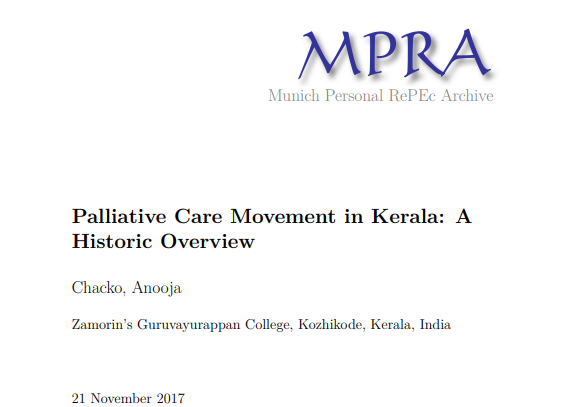
Palliative Care Movement in Kerala: A Historic Overview

Image
 Kerala, the southern state of India, is celebrated for its achievements in health and education, often cited as a development model by social scientists. However, the state's health system historically prioritized disease prevention and cure, overlooking the emotional and physical relief required by patients beyond the stage of curability. This gap led to the emergence of the palliative care movement, which gained prominence in Kerala, particularly in the Malabar region, setting a precedent for the rest of India. This paper traces the evolution, significance, and impact of the palliative care movement in Kerala’s health system, emphasizing its socio-economic and demographic contexts. Evolution of the Palliative Care Movement Kerala’s palliative care journey began in 1993 with the establishment of the first unit at Kozhikode Medical College, in collaboration with the Institute of Palliative Medicine (IPM). This initiative marked a paradigm shift in the state’s health model by integ...